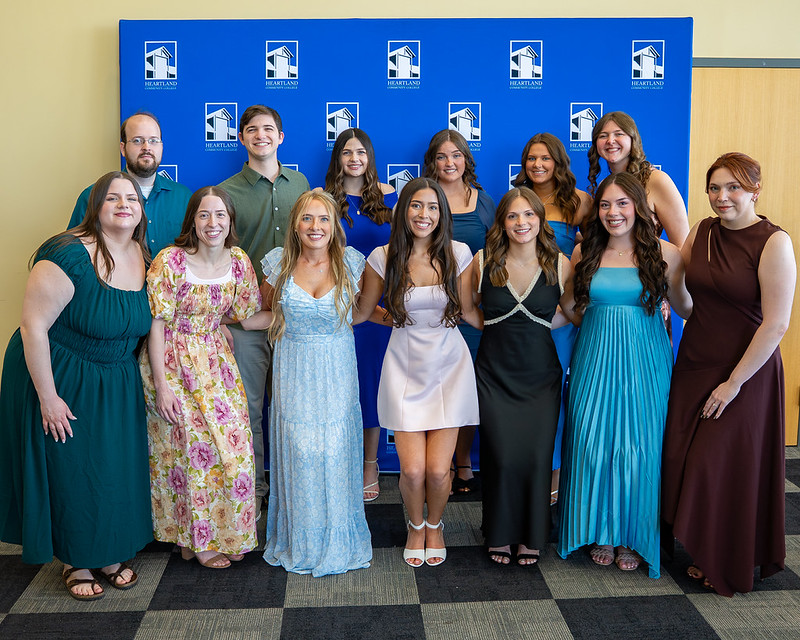
Kimberly Butler
Adjunct Instructor II
Teaches: Radiography
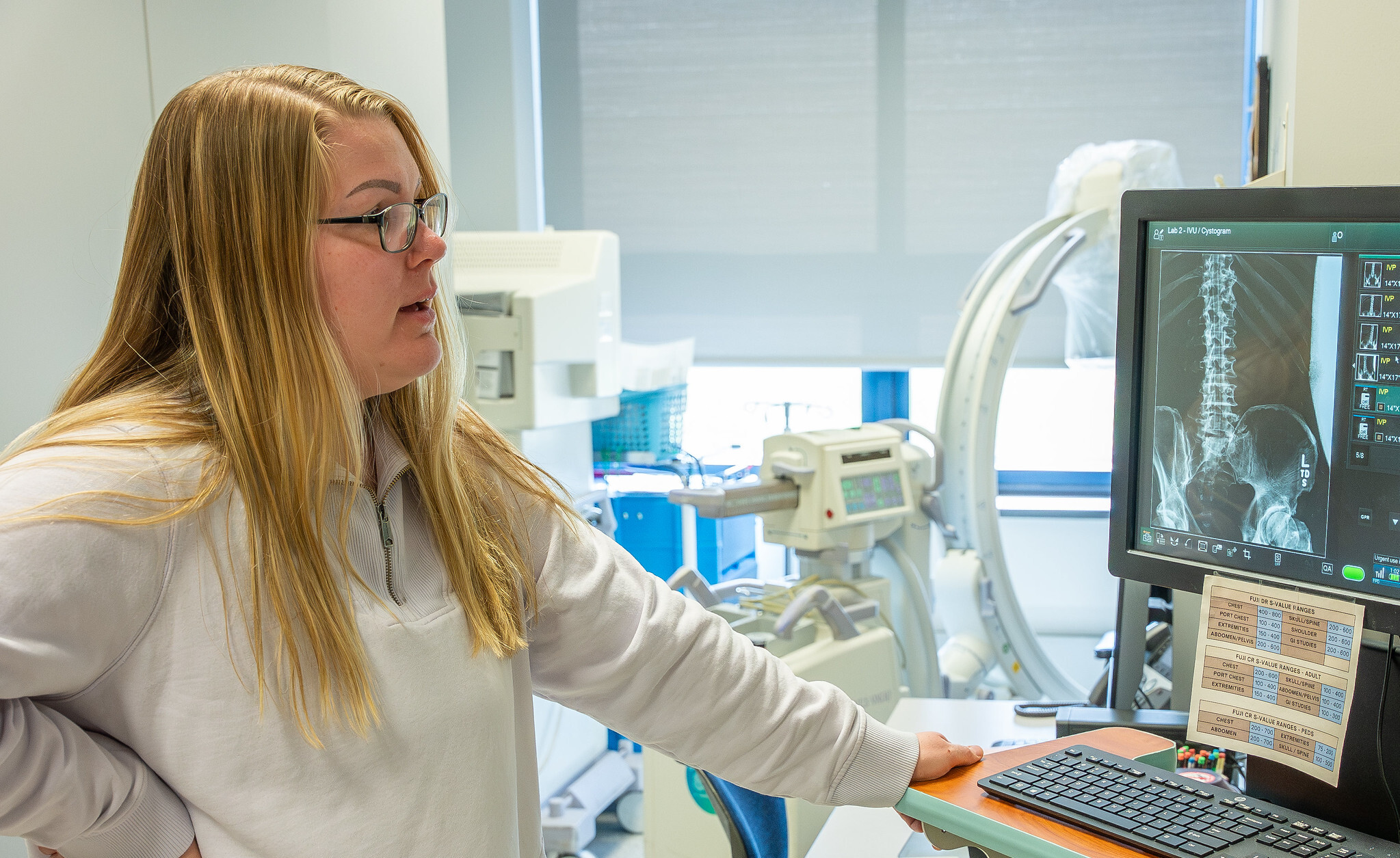
Radiography blends cutting-edge technology with meaningful patient interaction in a rewarding healthcare career. Radiologic technologists use X-rays to create images of the body’s internal structures, supporting physicians in diagnosing, treating, and monitoring diseases. In this program, you’ll develop skills to:
The two-year Associate degree Radiography program prepares students for a dynamic career as a radiologic technologist. Students will also learn about related imaging modalities, including computed tomography (CT), angiography, magnetic resonance imaging (MRI), and mammography. Radiography is an essential specialty within the radiologic sciences, complementing disciplines such as diagnostic medical sonography, nuclear medicine, and radiation therapy.
Overall employment of radiologic and MRI technologists is projected to grow 5 percent from 2024 to 2034, faster than the average for all occupations. About 15,400 job openings are projected each year, on average, over the decade, many due to workforce turnover and retirements.
Source: U.S. Bureau of Labor Statistics, Occupational Outlook Handbook – Radiologic and MRI Technologists (accessed February 16, 2026).
For more information about the radiography profession, visit American Society of Radiologic Technologists or RadAcademy.
There are many reasons to study at Heartland Community College:
Our program graduates secure positions across the healthcare landscape, including hospitals, outpatient imaging centers, urgent care facilities, and physician offices. Many go on to specialize in high-demand areas such as CT, angiography, and mammography, opening doors to versatile and fulfilling careers.
The Heartland Community College radiography program is accredited by the Joint Review Committee on Education in Radiologic Technology (JRCERT).
20 North Wacker Drive, Suite 2850
Chicago, IL 60606-3182
312-704-5300
Email: mail@jrcert.org
The program's current accreditation award is 8 years. View general program accreditation information and the current accreditation award letter.
The following is the most current program effectiveness data. The Joint Review Committee on Education in Radiologic Technology (JRCERT) defines and publishes this information. Visit the JRCERT program effectiveness data page .
The number of graduates who pass, on the first attempt, the American Registry of Radiologic Technologists (ARRT) certification examination (or an unrestricted state licensing exam) within six months of graduation. The JRCERT benchmark is a 75% five-year average.
| Year | Number passed on 1st attempt divided by number attempted within 6 months of graduation |
|---|---|
| 2020 | 8 of 8 – 100% |
| 2021 | 10 of 10 – 100% |
| 2022 | 0 of 0 – 0% |
| 2023 | 7 of 8 – 88% |
| 2024 | 7 of 10 – 70% |
| 5-Year Average | 32 of 36 – 89% |
Adjunct Instructor II
Teaches: Radiography
Professor I
Teaches: Radiography
Assistant Professor
Teaches: Radiography
The number of graduates employed in the radiologic sciences compared to those actively seeking employment within 12 months of graduation. The five-year average benchmark established by JRCERT is 75%.
| Year | Number employed divided by number actively seeking employment within 12 months of graduation |
|---|---|
| 2020 | 8 of 8 – 100% |
| 2021 | 10 of 10 – 100% |
| 2022 | 0 of 0 – 0% |
| 2023 | 8 of 8 – 100% |
| 2024 | 10 of 10 – 100% |
| 5-Year Average | 36 of 36 – 100% |
The number of students who complete the program within the stated program length. The annual benchmark established by the program is 65%.
| Year | Number graduated divided by number started the program |
|---|---|
| 2024 | 10 of 12 – 83% |
| Annual Completion Rate | 83% |
Policies, procedures, and other relevant Radiography Program information, including JRCERT Standards, can be found in the Program Handbook.
| Semester 1 - Summer | |
|---|---|
| Course | Hours |
| 3 |
|
| 3 |
|
| 3 |
| Semester 2 - Fall | |
|---|---|
| Course | Hours |
| 3 |
|
| 4 |
|
| 6 |
|
| 3 |
| Semester 3 - Spring | |
|---|---|
| Course | Hours |
| 4 |
|
| 3 |
|
| `` | 3 |
| 6 |
| Semester 4 - Semester 4 | |
|---|---|
| Course | Hours |
| 4 |
|
| 3 |
| Semester 5 - Fall | |
|---|---|
| Course | Hours |
| 3 |
|
| 2 |
|
| 3 |
|
| 2 |
|
| College Level Mathematics course |
3-4 |
| Semester 6 - Spring | |
|---|---|
| Course | Hours |
| 3 |
|
| College Level Mathematics course |
5 |
| 2 |
|
| 2 |
|
| 3 |
| Post-Graduation - Summer (CT Technologist Certificate) | |
|---|---|
| Course | Hours |
| 3 |
(Courses listed in italics denote in-sequence offerings for the optional 9-hour CT Technologist certificate.)
The Computed Tomography (CT) Technologist Certificate pathway is a three-course sequence that includes hands-on clinical experience. It prepares you to sit for the American Registry of Radiologic Technologists (ARRT) certification examination in Computed Tomography, opening doors to diverse working opportunities. Radiographers with an active Illinois Emergency Management Agency (IEMA) licensure and an ARRT credential in Radiography, Radiation Therapy, or Nuclear Medicine (including NMTCB) are eligible for this certificate program.
These courses fulfill the ARRT requirements for didactic education and are ARRT approved for the CT post primary certification.
Bloomington-Normal School of Radiography Registered Radiographers who wish to complete their A.A.S. degree should:
If you meet these criteria and would like more information, please email the Radiography Program Coordinator.
Heartland Community College maintains transfer agreements with:
Contact Financial Aid for information about scholarships or other assistance with program costs.
The following table was designed to provide information related to potential expenses incurred by the prospective student in the HCC Radiography Program. The totals may vary depending on previous completion of general education courses, costs associated with immunizations and tests, if you have health insurance, and if your insurance covers the costs of health-related testing and immunizations. The fees associated with a criminal background check and drug screening are estimates and are paid directly to the company performing the checks/screens. The ARRT exam fee and state license fee are for reference only and are not paid to Heartland Community College. If you elect to take the test and become licensed in a different state, you would be responsible for determining those fees. Travel fees are related to clinical education and vary dependent on location (generally held to within 90 miles of HCC) and current fuel costs.
| Item | Cost |
|---|---|
| Tuition & Fees: full radiography program (required courses) | |
| $169/credit hour (tuition) | $11,999 |
| $17/credit hour (college fees) | $1,278 |
| $1,100 (approximate course fees) | $1,100 |
| Books for entire 2 years of program | $970 |
| Clinical uniforms & shoes | $230 |
| CPR Certification (BLS for Healthcare Provider) | $35 - $70 |
| Personal health insurance (student responsibility) | Varies |
| ARRT Examination fee | $225 |
| State of Illinois License fee | $120 |
| Travel to clinical sites | Varies |
The tuition rate for radiography courses is the same as for all other Heartland courses.
There are a variety of immunizations required by our clinical partners. A list of immunizations will be distributed after acceptance into the program.
*All tuition, fees, and costs estimated are subject to change without notice.
As a selective admission program, the Radiography program accepts up to 15 students per cohort. The decision for admission is based on achievement of minimum academic criteria, residency, and the quality of the applicant's credentials in relation to those of other applicants.
Heartland Community College's Associate Degree of Radiography program does not accept students attempting to transfer from another Radiography program or seeking Advanced Placement in Radiography curricula to regain eligibility for ARRT certification and registry exam. These students must follow the application guidelines found in the Radiography admission packet and the degree requirements for ARRT. Applications will only be accepted during the open application period for the program that is published on the program's website. Any applications submitted outside of this time frame will not be accepted for consideration. All students, when admitted to the program, are required to follow policies and procedures as set forth by the program and college.
The College provides equal educational opportunities to all students and equal employment opportunities to all employees and applicants for employment. Management and supervisory personnel at all levels are responsible for taking reasonable and necessary actions to prevent discrimination. Discrimination is prohibited under Americans with Disabilities Act of 1990, the Rehabilitation Act of 1973, Title IX of the Education Amendments of 1972, the Violence Against Women Act of 1994, Title VII of the Civil Rights Act of 1964, the Age Discrimination in Employment Act of 1967, the Illinois Human Rights Act, and all other relatable laws, rules and regulations that apply to College operations.
Call or visit an academic advisor for assistance with course selection and the application process.
It is strongly recommended that anyone interested in applying for the Radiography program attend an informational meeting. Information meetings provide an overview of the Radiography program and the admission process. Though attendance is not mandatory, these meetings provide an opportunity to ask questions of Admissions and Radiography program staff and are intended to help make the application process as smooth as possible for prospective students. All information meetings are held at the main campus in Normal, IL, unless otherwise noted.
| Informational Session(s) | |
|---|---|
| Room | Day and Time |
| Please register for this event here. | Tuesday, March 3rd at 5:00 PM. |
Information about non-academic criteria for participation in the Radiography program (functional abilities and expectations, Criminal Background Check policy, and Drug Screening Policy) can be found in the Program Handbook.
The following statements must be answered by applicants seeking licensure in the State of Illinois, as well as to take the certification exam administered by the American Registry of Radiologic Technologists (ARRT). If you answer "yes" to any of the questions, you may be required to go through a due process prior to issuance of a license. You also will be required to complete the pre-application process to determine your eligibility to take the certification exam.
The above information should not deter you from applying for the Radiography program. Please discuss any questions with the Radiography Program Coordinator for specific information.
The decision to allow an individual to take the ARRT examination for licensure rests solely with the American Registry of Radiologic Technologists certifying board. Likewise, the decision to be granted an Illinois license after passing the examination rests solely with the Illinois Emergency Management Agency.
General education courses can be completed prior to admission. If general education courses are not completed prior to admission, they must be completed with a "C" or better during the semester indicated in the Curriculum Sequence.
The Radiography courses begin each summer for those applicants accepted into the program and can be completed in four semesters and two summer terms. These courses are offered only at the Normal Campus during the day and must be taken in order as outlined in the Curriculum Sequence. Due to the rigors of the program, students are encouraged to keep work hours at a minimum.
Clinical experiences are completed off campus in various practice settings each semester. Hours vary each semester and can include evening and/or weekend hours. Find more information about clinical education, clinical sites, and radiography health and safety information in the Program Handbook.
Step 1. Apply to Heartland Community College
Step 2. Apply to the Radiography Program. Application only available September 1-January 1**
** Applications may be reopened at a later date if seats remain available.
Step 3. Take the ATI Test of Essential Academic Skills (TEAS) Version 7
The ATI TEAS Version 7 is only offered online.
Study materials are available at the Heartland Library or may be purchased on the TEAS prep page.
Students may take the ATI TEAS Version 7 twice within an application cycle. The highest score of the two attempts will be used for evaluation. ATI TEAS Version 7 scores are valid for two application cycles.
The Heartland Community College Associate Degree Radiography Program accepts up to 15 students per class. This number is based on the following:
All qualified applicants will be ranked. Seats will be offered in rank order to qualified candidates to fill the class. This process will continue until all seats are filled, all qualified candidates have been exhausted, or the mandatory orientation date has occurred.
Evaluation/Ranking of Applicants
Please see our admission recommendation sheet for information on the evaluation and ranking of applicants. Additional information can be obtained by contacting the Director of Admissions at (309) 268-8058 or radiography.admissions@heartland.edu.
Applicants will be notified of their status regarding admission via their myHeartland email by March 15.
Applicants not accepted during an application cycle will receive an email explaining why their application could not be approved at this time. These applicants may reapply when admission requirements have been met.
Applicants accepted into the program must respond with an acceptance or declination by the date specified in the acceptance letter. Failure to respond will be considered a declination, and the seat will be offered to the next qualified applicant.
No early or late applications will be accepted. If seats remain open, applications may be reopened at a later date until all seats are filled or until the mandatory orientation date.
Applicants not accepted during an application cycle will need to submit a new application for the Radiography Program during a subsequent application cycle. Applications and waiting lists are not maintained from year to year.
Applicants who wish to appeal their status must submit a letter explaining any extenuating circumstances to radiography.admissions@heartland.edu by January 15 to be considered for entry into the Radiography Program in the Summer. Only one appeal per applicant is allowed.
Applicants who are offered a seat in the program must meet the following requirements prior to official acceptance into the program:
Yes, if you are caring and compassionate, accept responsibility, use good judgment, have initiative as an adult learner, are willing to be ethically and legally accountable for your actions, and are respectful of the rights of people of all ages, ethnic backgrounds, social status, and religious beliefs.
Heartland offers a full-time (including two summer sessions) Associate in Applied Science Degree in Radiography program. The program includes general (non-RAD) courses as well as radiography courses. We strongly encourage students to complete all or most of the general courses prior to being admitted to the Radiography program. Also, students may need to take English, math, or reading courses if placement testing indicates a student’s skills are below college level in any of these areas, and students will need to satisfy the BIOL 181 prerequisite if they have not previously completed the Anatomy and Physiology I course.
Once admitted to the program, Radiography students take classes for four consecutive semesters and two summer terms and graduate in May of their second year. The sequencing of radiography courses does not allow for a more rapid progression through the program even if general (non-RAD) courses have been completed prior to admission into the Radiography program.
Yes, however applicants are encouraged to complete the majority of general (non-RAD) courses prior to enrolling in the Radiography program. These courses are: BIOL 181, BIOL 182, ENGL 101, and a college-level math class. Please note that Technical Math does not satisfy the math requirement.
Yes, financial aid is available. Please check with the Financial Aid Office in Enrollment Services to determine your eligibility for financial aid and various college-wide scholarships.
To be eligible for admission, students must test into college-level math or take the appropriate courses to reach college-level math. The college placement test will tell you and your advisor if you need some assistance in meeting the radiography admissions requirement. You will not be admitted to the Radiography program until you have met this requirement.
The following courses will require students to complete math calculations: RAD 111, RAD 134, RAD 214, RAD 234, and RAD 236. A college-level math course is required as part of this curriculum.
Heartland does not carry over a waiting list of qualified applicants from year to year. Qualified students who are not admitted need to submit a new application the following year so that we are aware of their continued interest in the program.