
Jim Davis
EMS Educator
Teaches: Emergency Medical Technician Program
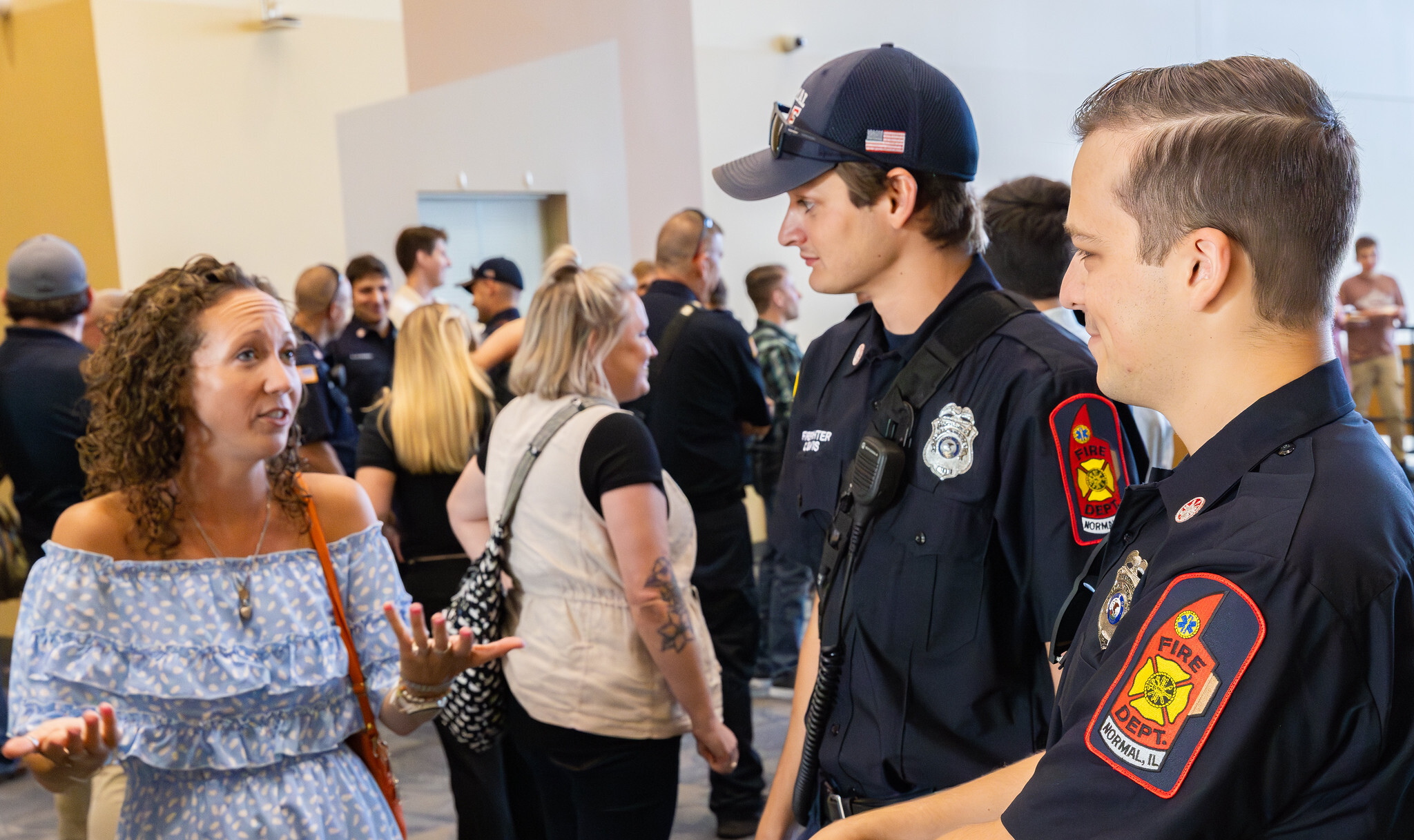
Emergency Medical Services is a system that provides emergency medical care. Heartland Community College and the McLean County Area Emergency Medical Services (MCAEMS) have teamed up to offer Emergency Medical Technician (EMT) courses. Whether you want to acquire the EMT Basic certification or continue on and obtain the EMT Paramedic certification, Heartland and MCAEMS have the courses that you need.
For questions about becoming an EMT or Paramedic, or the courses, contact Kierney Weirman, EMS Training Coordinator for MCAEMS, at 309-827-4348 or kweirman@mcleancountyems.org.
EMS is a field that is exciting, satisfying, and allows you to make a difference firsthand in your communities. Working in this field requires rapid and critical thinking, problem-solving skills, and compassion.
As an EMT you have the opportunity to care for the sick and injured and play a key role in their treatment before they arrive at a hospital. In this role, you are a first responder to medical and traumatic emergencies and work closely with other public safety personnel and healthcare professionals to provide immediate care.
You can find our graduates working in many different areas of public safety such as:
They have also gone on to careers such as nursing, nurse anesthetists, and more.
There are many reasons to study at Heartland Community College.
8 credit hours, Catalog Year 2025–2026
EMT Basic courses will be offered every fall and spring semester as both day and night classes.
| Certificate Requirements | |
|---|---|
| Course | Hours |
| 8 |
|
| Total Credit Hours |
8 |
37 credit hours, Catalog Year 2025–2026
The EMT–Paramedic certificate program includes required general education coursework and a three-course paramedic sequence. Students may complete the paramedic sequence through one of two tracks.
Track 1 begins in the summer semester and consists of EMT 235, EMT 236, and EMT 237. Track 2 begins in the fall semester and consists of EMT 245, EMT 246, and EMT 247.
Students must successfully complete each course with a grade of “C” or higher to progress to the next course in the sequence. All paramedic courses must be taken consecutively within a continuous three-semester sequence. To be considered passing and eligible for licensure, students must earn a final program average of “B” or higher.
The EMT–Paramedic curriculum consists of classroom lecture, lab, and clinical & field experience. Clinical experiences occur in hospital settings (e.g., Emergency Department, Cardiac Cath Lab, Intensive Care Unit, Operating Room), and field experiences occur on an ALS ambulance.
| Certificate Requirements | |
|---|---|
| Course | Hours |
| BIOL 121 – Essentials of Anatomy & Physiology |
4 OR 8 |
| 9 |
|
| 12 |
|
| 12 |
|
| Total Credit Hours |
37-41 |
| Certificate Requirements | |
|---|---|
| Course | Hours |
| BIOL 121 – Essentials of Anatomy & Physiology |
4 OR 8 |
| 12 |
|
| 12 |
|
| 9 |
|
| Total Credit Hours |
37-41 |
EMS Educator
Teaches: Emergency Medical Technician Program
EMS Educator
Teaches: Emergency Medical Technician Program
EMS System Manager
Teaches: Emergency Medical Technician Program
EMS Educator
Teaches: Emergency Medical Technician Program
EMS Educator
Teaches: Emergency Medical Technician Program
The EMT-Basic (EMT-B) program is designed to prepare students to enter the pre-hospital care field through classroom lectures, hands-on skills in lab settings, and field experience in hospital emergency rooms and with ambulance services/fire department EMTs.
Students who complete the Heartland Community College EMT-B Program are eligible to take the National Registry of Emergency Medical Technicians (NREMT) certification examination.
National Registry of Emergency Medical Technicians (NREMT) certification validates basic competencies in emergency medical services (EMS). However, it’s important to understand that NREMT certification alone does not grant you a license to practice in any state.
In summary, NREMT certification provides a foundation, but you must obtain a state license to practice. Always check with the state EMS office where you plan to work for current requirements.
To register for the EMT-Basic course EMT 101, students must meet the following requirements:
* Per Illinois law, students who complete the program before age 18 may test but cannot be licensed until their 18th birthday.
** Students must possess a high school diploma or equivalent at the time of licensure application.
Registration for EMT 101 closes at midnight on the Sunday before classes begin.
EMT 101 is an 8-credit/9-contact-hour course with 7 hours of lecture and 2 hours of lab weekly over 16 weeks. Students must also complete 28 hours of clinical experience in settings such as emergency departments, dispatch centers, and ambulances.
Essential Functions of the Job
Students must be able to perform the following with or without reasonable accommodations:
Students may contact Student Access and Accommodation Services with any concerns.
A background check is required for clinical participation. Students must complete authorization forms during the first week. View disqualifying convictions and waiver information .
Students with disqualifying results must complete a waiver before entering clinical settings.
A 10-panel urine drug test is required for clinical participation.
Proof of the following is required before clinical placement:
This certificate is a 37-credit-hour, three-semester program that includes general education coursework, EMT courses, and clinical and field experiences.
Students completing the Heartland Community College Paramedic Program are eligible to take the National Registry of Emergency Medical Technicians (NREMT) paramedic certification examination.
National Registry of Emergency Medical Technicians (NREMT) certification validates core EMS competencies. However, it is important to understand that NREMT certification alone does not grant you a license to practice in any state.
In summary, NREMT certification provides a foundation, but you must obtain a state license to practice. Check with the state EMS office where you plan to work for current requirements.
To register for EMT 245 – Paramedic I, students must meet the following:
* Students under 18 may test but cannot be licensed until age 18.
** Must be completed before licensure application.
EMT-Paramedic courses meet approximately 10 hours per week over two days, including lecture and lab. Students also complete about 200 hours of clinical experience per course in hospital and ambulance settings.
Students must be able to:
For accommodations, contact Student Access and Accommodation Services.
Required for clinical participation. View disqualifying convictions and waiver information .
Students must complete any required waiver before entering clinical settings.
A 10-panel urine drug test is required for clinical participation.
Required prior to clinical placement:
Upon successful completion of the program, students will be able to:
| 2022 | 2023 | 2024 | |
|---|---|---|---|
| Retention | 58% | 92% | 94% |
| NREMT Exam | 85% | 100% | 70% |
| Placement | 100% | 100% | 100% |
The Paramedic Program is offered through Heartland Community College and is sponsored by a CoAEMSP-accredited consortium including Heartland Community College, OSF St. Joseph Medical Center, Carle BroMenn Medical Center, and the McLean County Area EMS System. Program instruction is provided by MCAEMS personnel, with clinical education conducted at OSF St. Joseph Medical Center and Carle BroMenn Medical Center.
The program is accredited by the Commission on Accreditation of Allied Health Education Programs (www.caahep.org) upon the recommendation of the Committee on Accreditation of Educational Programs for the Emergency Medical Services Professions (CoAEMSP).
Contact Financial Aid for information about scholarships or other assistance with program costs.
The tuition rate for EMT courses is the same as other Heartland courses.
The following table provides estimated expenses for prospective EMT paramedic students. Totals may vary depending on previously completed coursework and immunizations.
| Item | Cost |
|---|---|
Tuition and fees for the paramedic program*:
|
$6,919 |
|
$13,172 |
Course-specific fees**:
|
Plus $1,131 |
| Books | Approx. $479 |
Additional immunizations are required by clinical partners. Specific requirements will be provided after program acceptance.
* Tuition estimates do not include prerequisite courses (BIOL 121 or BIOL 181 and 182).
** Course lab fees include equipment, uniforms, and specialized training.
All tuition, fees, and cost estimates are subject to change without notice.